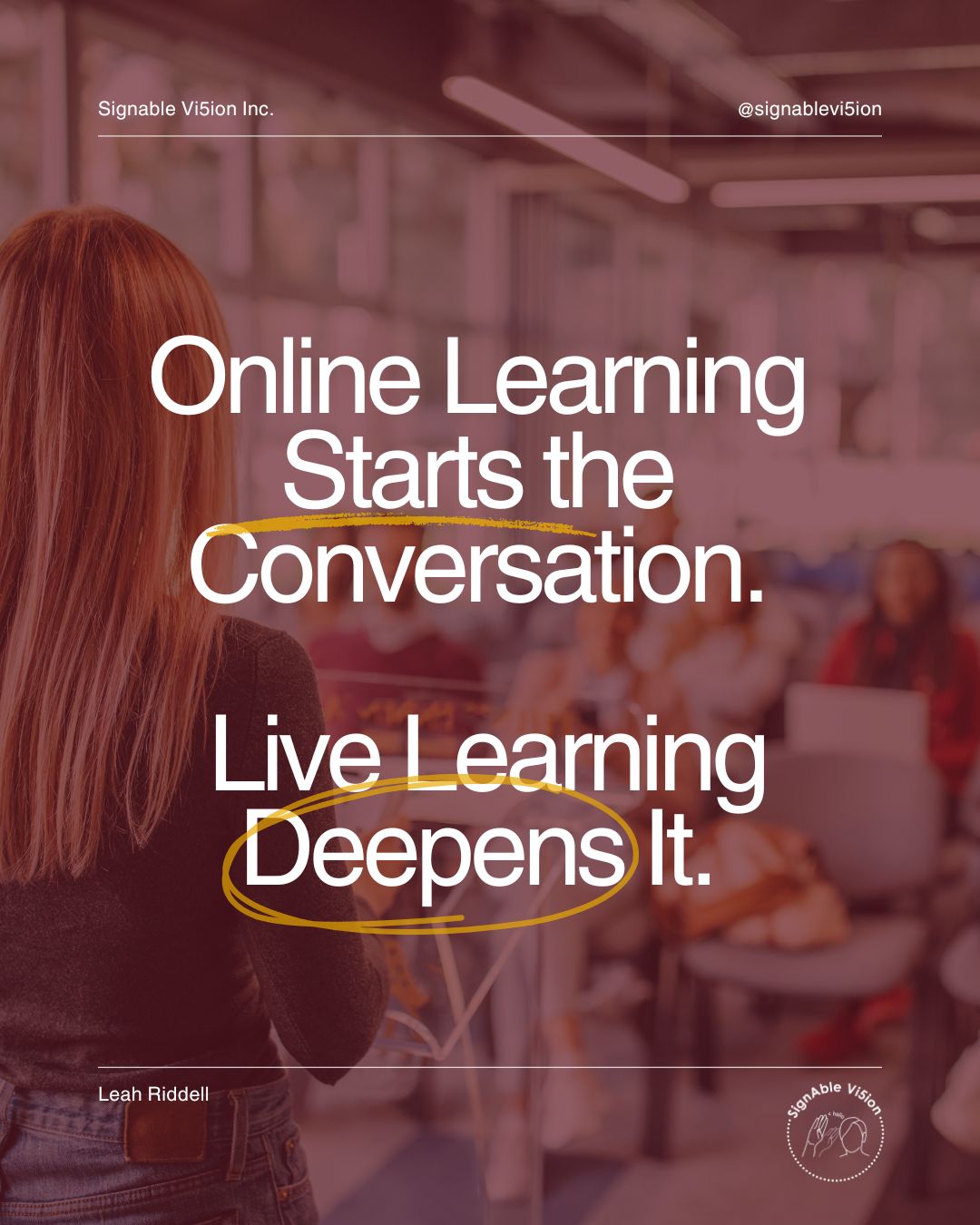
Online Learning Starts the Conversation. Live Learning Deepens It.

A person stands at the front of a room facing an audience during a live presentation. The image is overlaid with a muted burgundy tint. Large white text reads, "Online Learning Starts the Conversation. Live Learning Deepens It." with gold hand-drawn circles emphasizing the words "Conversation" and "Deepens It." The SignAble Vi5ion Inc. name appears at the top left, @signablevi5ion at the top right, and Leah Riddell's name and the SignAble Vi5ion logo appear along the bottom.

Share This Post

I’ve been noticing more online courses and learning apps focused on Deaf awareness and accessibility. I think that’s a positive step. They make learning more accessible, give people a place to start, and help introduce concepts that many people have never been exposed to before.

But online learning can only take you so far.

Most online courses are designed to share information. They explain concepts, provide examples, and ask you to reflect. What they can’t do is respond to your questions, challenge assumptions, or explore the unique situations that exist within your own workplace or organization.

That’s where live learning makes a difference.

When I facilitate training, we rarely spend our time repeating what’s already in a course. Instead, we unpack it. People ask questions they didn’t know they had until they heard someone else’s experience. We work through real situations from their workplace. We discuss communication challenges, accessibility barriers, and practical solutions that fit their environment—not generic examples that try to apply to everyone.

One thing I’ve learned over the years is that no two organizations are alike. A municipality faces different challenges than a healthcare provider. A museum has different accessibility needs than a business or a school. Those conversations shape the training because they’re based on real experiences, not hypothetical situations.

I’ve also found that every workshop teaches me something. Participants share perspectives, ask thoughtful questions, and identify gaps that help me continue improving future training. Accessibility is constantly evolving, and so is the way we teach it.

Online learning is an excellent starting point. It builds awareness and introduces important ideas. Live learning is where those ideas become meaningful, practical, and relevant to the people doing the work. When the two are combined, learning becomes much more than completing a course, it becomes understanding how accessibility looks in everyday practice.

More To Explore

A woman wearing a colourful patterned shirt stands at the front of a room, signing in Oneida Sign Language. A warm orange overlay covers the image. Large white text reads, “When Deaf Education Also Meant Losing Your Indigenous Language,” with an underline for emphasis. SignAble Vi5ion Inc. branding appears at the top, with Leah Riddell’s name and logo at the bottom.

When Deaf Education Also Meant Losing Your Indigenous Language

Today is the National Day for Truth and Reconciliation. When we talk about the history of residential schools, language loss and colonization, there is another experience that I believe needs much more attention: Indigenous Deaf people. For many Indigenous Deaf children, getting an education meant leaving their home community and travelling far away to attend a school for the Deaf. They may have gained access to other Deaf

Read More »
A woman wearing a polka-dot blouse communicates in sign language while seated at a desk with a laptop. A burgundy overlay covers the image. Large white text reads, “We Are More Than Our Hearing Levels,” with a yellow underline for emphasis. SignAble Vi5ion Inc. branding appears at the top, with Leah Riddell’s name and the company logo at the bottom.

We Are More Than Our Hearing Levels

A special message for Deaf Awareness Month, International Week of Deaf People and International Day of Sign Languages — September 23 Every September, I see organizations celebrating Deaf Awareness Month, International Week of Deaf People and International Day of Sign Languages. I appreciate the recognition, but I also notice how often Deaf awareness is presented alongside hearing aids, cochlear implants, hearing tests and information about hearing loss. We

Read More »