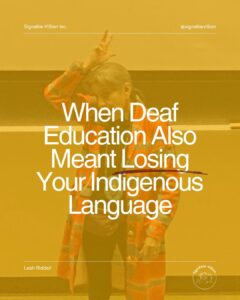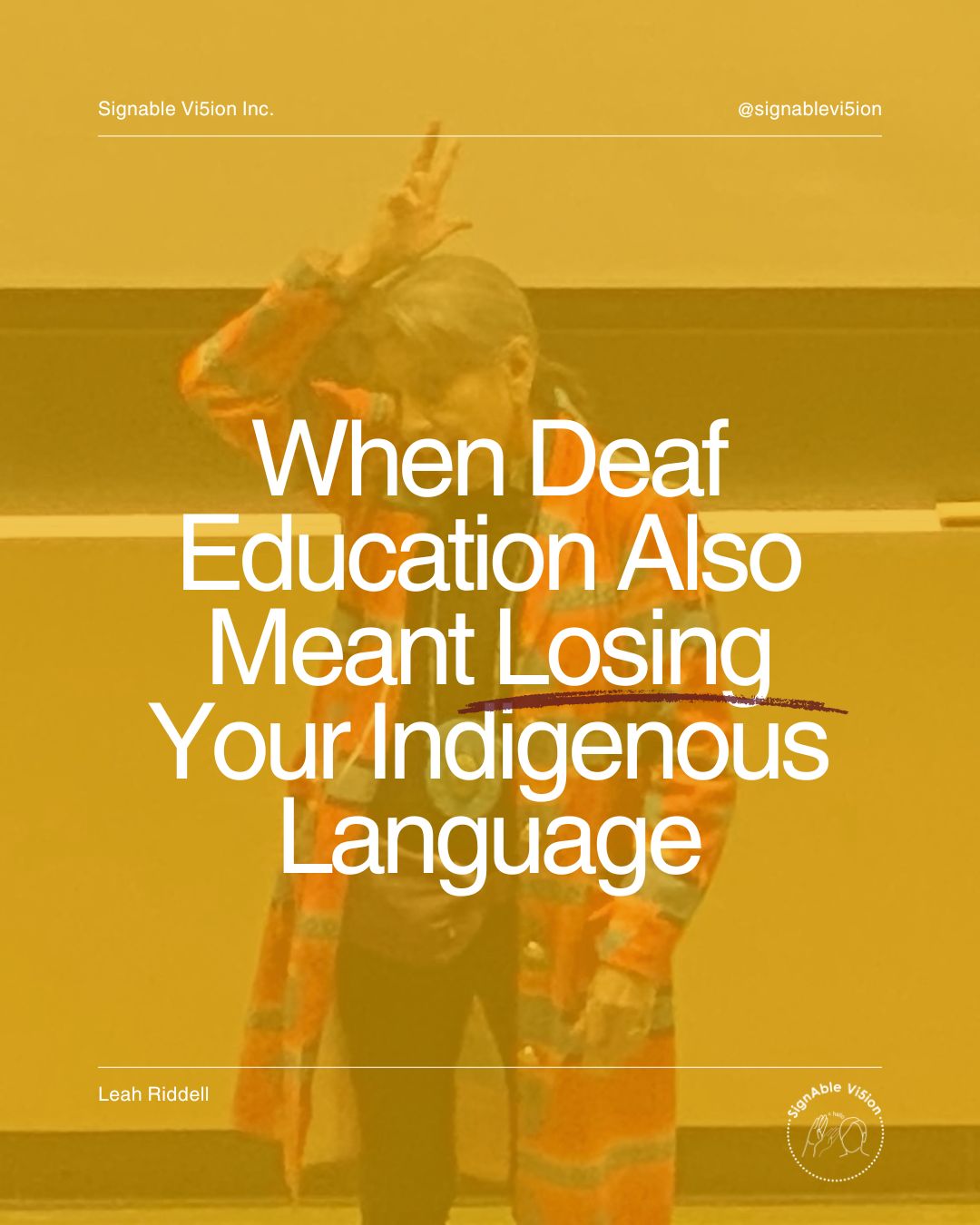
Today is the National Day for Truth and Reconciliation. When we talk about the history of residential schools, language loss and colonization, there is another experience that I believe needs much more attention: Indigenous Deaf people.
For many Indigenous Deaf children, getting an education meant leaving their home community and travelling far away to attend a school for the Deaf. They may have gained access to other Deaf children and eventually sign language, but there was another loss happening at the same time. Their Indigenous language, culture, traditions and connection to their own community were not being carried with them into those schools.
That history is complicated. Deaf schools have an important place in Deaf history because they brought Deaf children together and helped Deaf communities and sign languages grow. But we also need to acknowledge that the same institutions did not necessarily honour the Indigenous identities of the children who entered them.
This is why I think we need to listen carefully to people like Teyuhuhtakweku, Marsha Ireland, a Deaf Oneida woman from the Turtle Clan of the Oneida Nation of the Thames. She has spoken publicly about attending a school for the Deaf and about the impact colonization had on her language, culture and identity. In testimony before a House of Commons committee, she described the revitalization of Oneida Sign Language as part of reclaiming those connections. House of Commons of Canada
Her experience makes us think beyond the usual way we talk about Deaf education.
Imagine being Deaf and Indigenous and being told that education requires you to leave the community where your culture lives. At school, English becomes part of your education and ASL becomes your signed language, while the language of your own Nation becomes increasingly distant.
Then imagine going home to ceremonies where your family and community are speaking Oneida, but the interpretation you depend on cannot follow when the language changes from English to Oneida. Max Ireland described exactly this experience when speaking about Marsha before Parliament: she could be physically close to her language and traditions while still being unable to fully access them. House of Commons of Canada
That is something many of us in the broader Deaf community need to think about.
We fight for sign language because we understand that language is connected to identity. We know what happens when Deaf children are denied access to a language they can fully understand.
But Indigenous Deaf people can experience another layer of language loss.
Access to ASL does not automatically restore access to Oneida language, culture or traditional knowledge. An ASL interpreter cannot simply replace an Indigenous language. Indigenous sign languages carry their own cultural knowledge and ways of expressing the world.
That is what makes the work around Oneida Sign Language (OSL) so important.
Marsha and Max Ireland have worked with the Oneida Language and Cultural Centre and fluent Oneida speakers to revitalize and develop Oneida Sign Language. The Centre explains that OSL is not simply spoken Oneida translated into ASL; its development also draws on Indigenous Hand Talk traditions. Oneida Language & Cultural Centre
For Marsha, this work is much bigger than creating signs.
It is about identity.
It is about Deaf Oneida children being able to belong to both their Deaf and Indigenous communities without being asked to choose between them.
It is about knowledge being passed from Elders to another generation in a language Deaf community members can access.
And it is about reclaiming something colonization interrupted.
Marsha has said that revitalizing Oneida Sign Language has helped strengthen language, culture and identity and reconnect her with her people and cultural ties. House of Commons of Canada
That is reconciliation too.
As a Deaf person and educator, I believe our own Deaf community also has a responsibility to learn this history. We cannot talk about protecting sign languages while assuming ASL is the answer for every Deaf person. We cannot celebrate Deaf schools without also being willing to hear the experiences of Indigenous Deaf people whose time in those systems included cultural and linguistic loss.
Today should not only be about remembering what happened.
It should also be about recognizing the people doing the work of reclamation now.
People like Marsha Ireland.
Indigenous Deaf people are reclaiming languages, cultural knowledge and identities that systems tried to separate from them. Their stories belong in our conversations about Deaf history, Indigenous language revitalization and reconciliation.
Every Child Matters includes Deaf Indigenous children too.
And language matters because language is more than communication.
Language carries identity, culture, history and belonging.