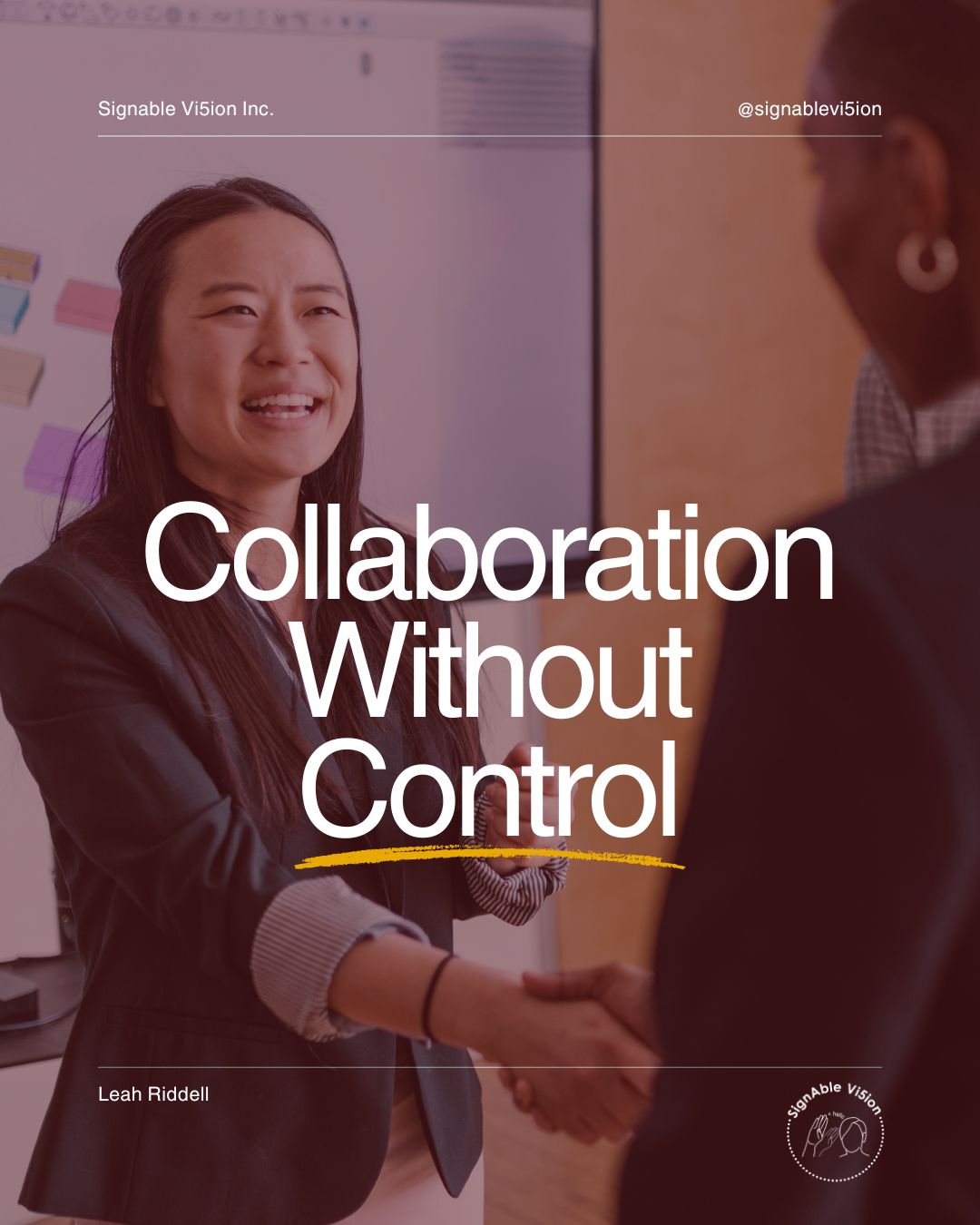
“Let’s collaborate.”
It’s a phrase I hear often; in emails, proposals, and partnership conversations.
And collaboration is a good thing.
But collaboration without shared power is not partnership.
It’s control with softer language.
When Collaboration Sounds Good, But Isn’t Equal
Sometimes collaboration looks like this:
Deaf professionals are invited to contribute.
Asked to provide expertise.
Brought in to review or deliver.
But the structure is already built.
The funding is already secured.
The decisions are already made.
In those cases, collaboration becomes participation, not partnership.
One side holds ownership.
One side holds final authority.
One side holds long-term benefit.
That’s not collaboration. That’s controlled inclusion.
Real Collaboration Requires Shared Power
True collaboration means:
- Shared decision-making
- Shared visibility
- Shared ownership where appropriate
- Transparent budgets
- Clear roles and authority
- Mutual respect for lived expertise
It means Deaf leadership is not an add-on, it is embedded in the foundation.
Collaboration should strengthen both sides.
Not quietly centralize power on one.
Why This Matters Now
As accessibility grows in visibility – especially in education, corporate spaces, and digital platforms – more organizations want to “partner” with Deaf professionals.
That’s encouraging.
But partnership cannot mean:
“Help us execute our idea.”
It must mean:
“Let’s build this together.”
The difference is structural, not cosmetic.
The Shift from Control to Trust
Shared power requires trust.
Trust that Deaf expertise is not just valuable, it is essential.
Trust that lived experience shapes stronger outcomes.
Trust that leadership can be shared without losing control.
That shift can feel uncomfortable.
But growth usually does.
If You Want to Do This Right
If your organization is working in ASL, accessibility, or Deaf community spaces and you genuinely want collaborative, Deaf-led partnership, start here:
- Bring Deaf leadership into the conversation early.
- Discuss decision-making roles before deliverables.
- Be transparent about ownership, funding, and long-term goals.
- Build structures, not just contracts.
- Be open to shifting your original idea.
Collaboration works best when it is built on equity, not hierarchy.
Ready to Move Beyond Optics?
If you’re serious about building Deaf-led or truly collaborative initiatives, not just Deaf-informed ones, let’s talk.
I work with organizations to:
• Design inclusive communication strategies
• Build Deaf-led frameworks
• Develop equitable partnerships
• Review structures, not just materials
• Move from performative inclusion to practical implementation
Real collaboration is possible.
It just requires intention, and the willingness to share power.
Reach out to start the conversation.