There’s a growing interest in learning ASL right now. Workplaces want to improve communication, service providers want to be more inclusive, and individuals are genuinely curious and motivated. On the surface, it looks like progress.
But something isn’t translating.
People are signing up for classes, attending a few sessions, learning some vocabulary, and then it fades. They stop using it. They lose confidence. Eventually, they feel like they didn’t really learn much at all.
It’s easy to assume it’s a lack of commitment, but that’s not what I’m seeing.
The issue is that the learning often doesn’t connect to their reality.
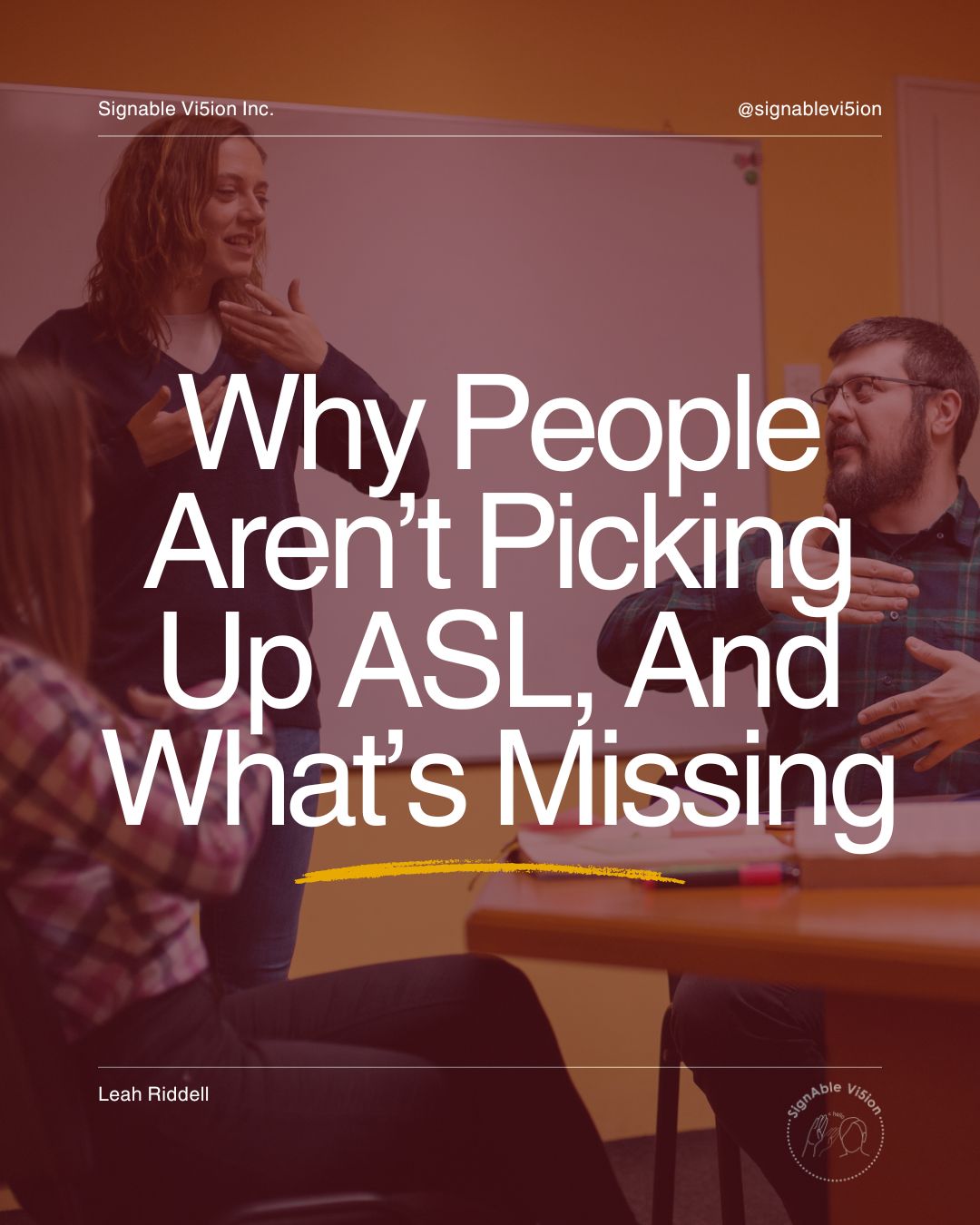
Many ASL programs are designed in a general way. They introduce common signs, basic structure, and standard topics. That works as an introduction, but it doesn’t always carry into real-life situations. People leave knowing signs, but not knowing how to actually use them in their own environment.
A front desk worker might learn signs for family or hobbies, but not how to greet and support a Deaf client. A healthcare provider might learn vocabulary, but not how to manage communication in a real appointment. A team might go through a course together, but still feel unsure when a Deaf person walks into their space.
Without relevance, the learning stays surface-level.
And when it stays surface-level, it doesn’t stick.
ASL isn’t just about memorizing signs. It’s about communication in context. It’s about knowing what to do when something isn’t understood, how to adjust, how to keep the interaction going. That kind of confidence doesn’t come from a standard lesson, it comes from practice that reflects real situations.
That’s where customization makes a difference.
When people see themselves in the learning – their job, their environment, their actual interactions – something shifts. The signs start to make sense. The practice feels useful. They begin to apply it, even in small ways, and that builds momentum.
It doesn’t have to be perfect. It just has to be relevant.
And once it’s relevant, people keep going.
I’ve seen this over and over again. When training is adapted to the people in the room, participation changes. Confidence grows. And most importantly, the learning stays with them because they’re using it, not just remembering it.
That’s the difference between taking a course and actually learning a language.
If ASL training hasn’t worked in the past, it doesn’t necessarily mean people weren’t capable or interested. It may just mean the approach didn’t meet them where they are.
And that’s something we can change.
If you’re looking at ASL training for your team or organization and want it to actually carry over into real communication, I’m always open to a conversation about what that could look like in your environment.