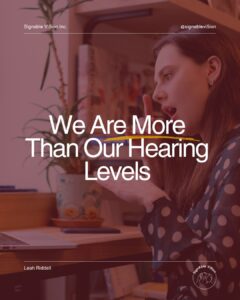
The Compliment That Isn’t
If you’ve ever said “You speak so well for a Deaf person,” please, take a deep breath. I know you probably meant it as a compliment, but to us, it’s a punch to the gut wrapped in politeness.
Where It Comes From
That phrase has a long, heavy history.
For decades, Deaf children were forced to learn to speak and lipread while being forbidden to use sign language. We were trained. drilled, really, to move our lips “properly,” to mimic sounds we couldn’t fully hear, to make speech comfortable for hearing people.
Sign language was banned in schools. Teachers tied hands, scolded, punished. Success was measured by how “normal” our voices sounded, not by how much we understood or were understood.
So when someone says, “You speak so well,” what we hear underneath is:
“You sound almost like us. Good job fitting in.”
It’s not about language ability, it’s about conformity.
The Hidden Cost of “Speaking Well”
Many of us learned to speak and lipread out of survival. Not choice. Not inclusion.
We were told to adapt; to do the hard listening, the guessing, the smiling when we missed something. We worked double-time to understand conversations that were never designed for us.
And even then, one slip, one mispronounced word, one misunderstood question, could bring instant criticism.
“What? That’s not what I said!”
“You didn’t hear me right.”
“Oh… never mind.”
It’s exhausting. And isolating.
When you’re constantly adapting to everyone else’s comfort, the experience is not inclusive, it’s performative. You end up fluent in pretending.
Language Is More Than Sound
Speech doesn’t equal intelligence.
Lipreading doesn’t equal access.
And “sounding hearing” doesn’t make us belong.
For Deaf people, sign language is our full, visual, accessible language. It connects us to culture, identity, and community; all the things speaking and lipreading never fully gave us.
So when someone says, “You speak so well for a Deaf person,” it’s not a compliment; it’s a reminder of how hard we’ve had to work to fit into a world that rarely meets us halfway.
What To Say Instead
If you want to acknowledge communication, try this:
“I appreciate how clearly you communicate.”
or
“Thanks for helping me understand.”
Those recognize effort on both sides, not just one.
The Takeaway
We don’t need praise for surviving an outdated system.
We need understanding that communication should be shared, accessible, and equal.
Because the real goal isn’t to “speak well.”
It’s to be understood, and respected, as we are.