I saw something recently that made me pause.
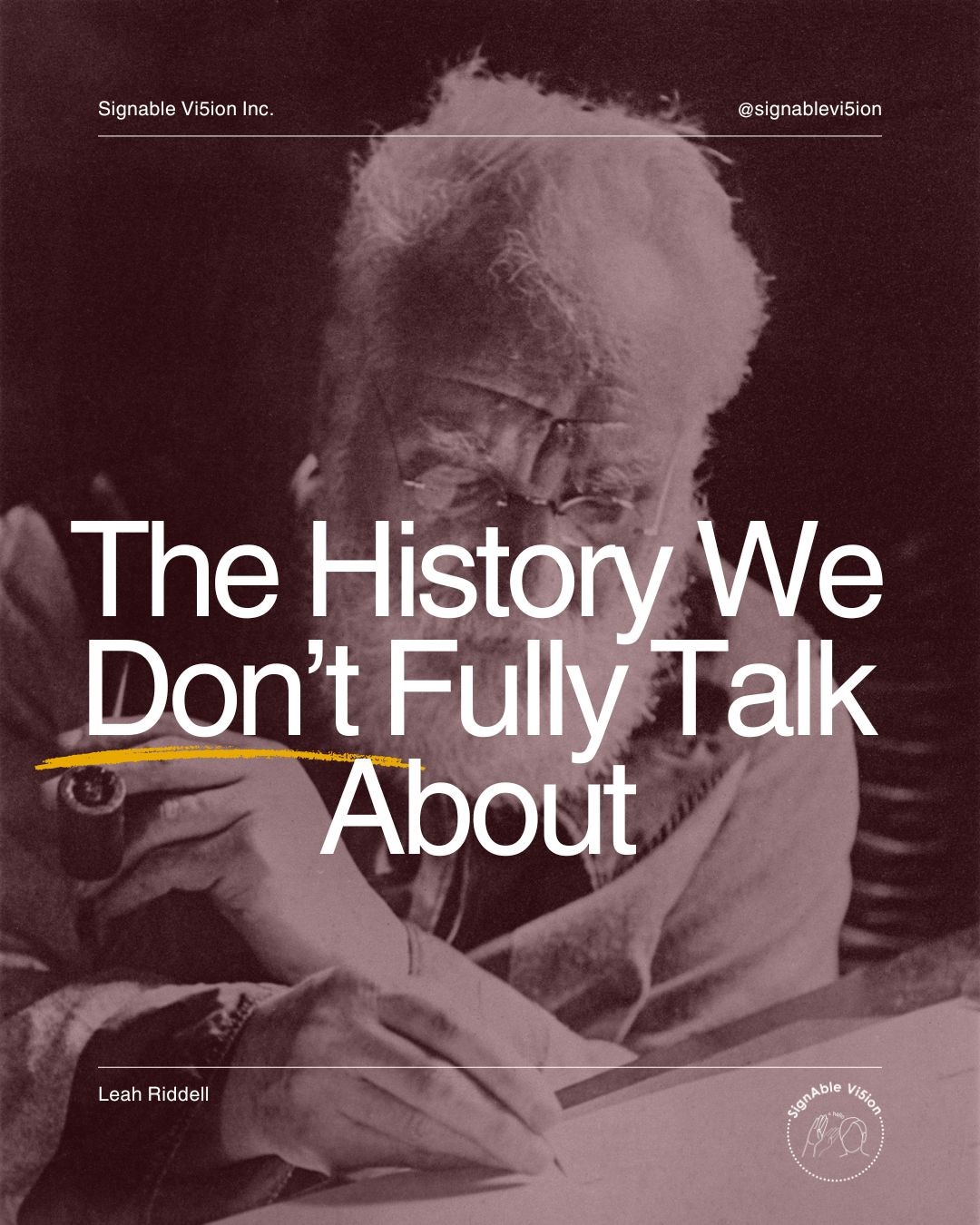
It was about Alexander Graham Bell. Most people know him for the telephone. That’s usually where the story starts and ends; innovation, progress, communication.
But there’s another part of that history that doesn’t get talked about as often.
And it still shows up today.
Bell’s connection to the Deaf community was personal. His mother was deaf, and sign language was part of their communication. Later, he married one of his students, who had become deaf at the age of five and had already developed speech. These experiences are often used to position him as someone deeply connected to Deaf people.
But that’s not the full picture.
Over time, he became one of the strongest advocates for oralism; the belief that Deaf people should rely on speech and lip-reading, and that sign language should not be used. He used his position, influence, and even his personal connections to support that direction.
That thinking didn’t stay at the individual level.
It shaped systems.
The Milan Congress in 1880 pushed sign language out of classrooms. Deaf teachers lost their jobs. Generations of Deaf children were raised without access to language in the way they needed it. That impact didn’t just disappear, it carried forward.
And in many ways, it’s still here.
You can see it in education systems that continue to prioritize speech over language access. You can see it in environments where sign language is treated as something secondary, something optional, or something to be added later instead of recognized as a complete language.
It doesn’t always look the same as it did then.
But the thinking hasn’t fully left.
That’s why this history matters.
Not to erase anything, but to understand what shaped the systems we’re still working within.
At the same time, there’s another side that often gets overlooked.
Deaf gain.
When Deaf people communicate visually, it doesn’t just benefit Deaf individuals. It changes how communication works for everyone. It brings clarity, attention, and a different way of processing information.
We see this all the time now. Texting. Video calls. Visual alerts. The way information is presented more visually and intentionally.
These shifts didn’t come out of nowhere.
They reflect ways of communicating that have always existed within Deaf communities.
So when we talk about history, it’s not just about what was taken away. It’s also about recognizing what has come from Deaf people and continues to shape how we communicate today.
Both need to be part of the conversation. Because when we only tell part of the story, we miss how much it still affects what we see now.
If you’re starting to notice how these patterns show up in your own space – in education, workplaces, or services – that awareness matters. Understanding the history helps explain the present. And that’s where change can begin.
If you’re ready to move forward in a way that fully respects language, culture, and communication, I provide training to help you get there.