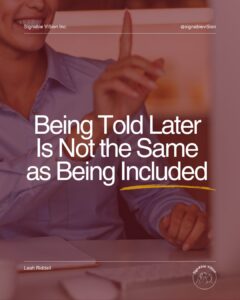
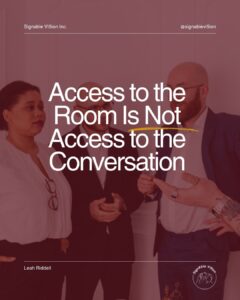
When it comes to Deaf experiences, everyone seems to have an opinion , especially those who haven’t lived it.
We often see professionals, parents, or “experts” speaking for the Deaf community, from early childhood education to adult accessibility. Their intentions might be good, but the result is often one-sided. The voices of those who actually live the Deaf experience get pushed aside or left out of key conversations.
The Problem with “Speaking For”
There are many variations of Deaf experience, no one speaks for all of us. But it’s especially concerning when people speak on behalf of Deaf children and Deaf adults without having walked in our shoes.
In education, healthcare, and workplaces, decisions are often made about us, not with us. The narrative too often centers around listening and speaking as the ultimate goal, as if communication success depends on how “hearing” a Deaf person can appear.
But that’s not inclusion. That’s assimilation.
One View Isn’t Enough
Listening and speaking are just one part of communication, not the whole picture.
Children and adults alike deserve access to all tools; sign language, visual supports, interpreters, captioning, Deaf role models, and inclusive communication practices, to make understanding easier, not harder.
When systems only promote one method, they put the burden of communication on the Deaf person.
Whether it’s a child in school or an adult in the workplace, we are expected to adapt to everyone else, instead of building environments where communication flows both ways.
No one should have to work twice as hard just to be understood.
Support should be about access, not assimilation.
Let Deaf Voices Lead
Representation matters at every stage of life.
Deaf adults bring lived experience that no textbook or “expert” perspective can replicate, and Deaf children need to see those role models.
We know the long-term effects of language deprivation, the exhaustion of constant adaptation, and the joy that comes from genuine communication access.
When hearing people speak for us, whether about Deaf children’s education or adult accessibility, they often miss the most important truth:
Deaf people know what Deaf people need, because we live it every day.
The Real Goal
Inclusion doesn’t mean making Deaf people fit into hearing systems. It means building systems that respect every form of communication and every person’s right to language and access.
So before anyone speaks for us, listen to us.
Because the best voices to represent Deaf experiences are the ones living them.
Hear My Story
I’ve lived through it, from being the only Deaf child in a public school, to being placed in “special education” with a Teacher of the Deaf, and finally, to attending a School for the Deaf where I truly found language and belonging.
Each experience shaped how I see access, identity, and inclusion, and it’s why I speak up today.
Before deciding what’s “best” for Deaf children or adults, hear our stories. Learn from those who have lived through the systems you’re shaping.
That’s where true understanding begins.